
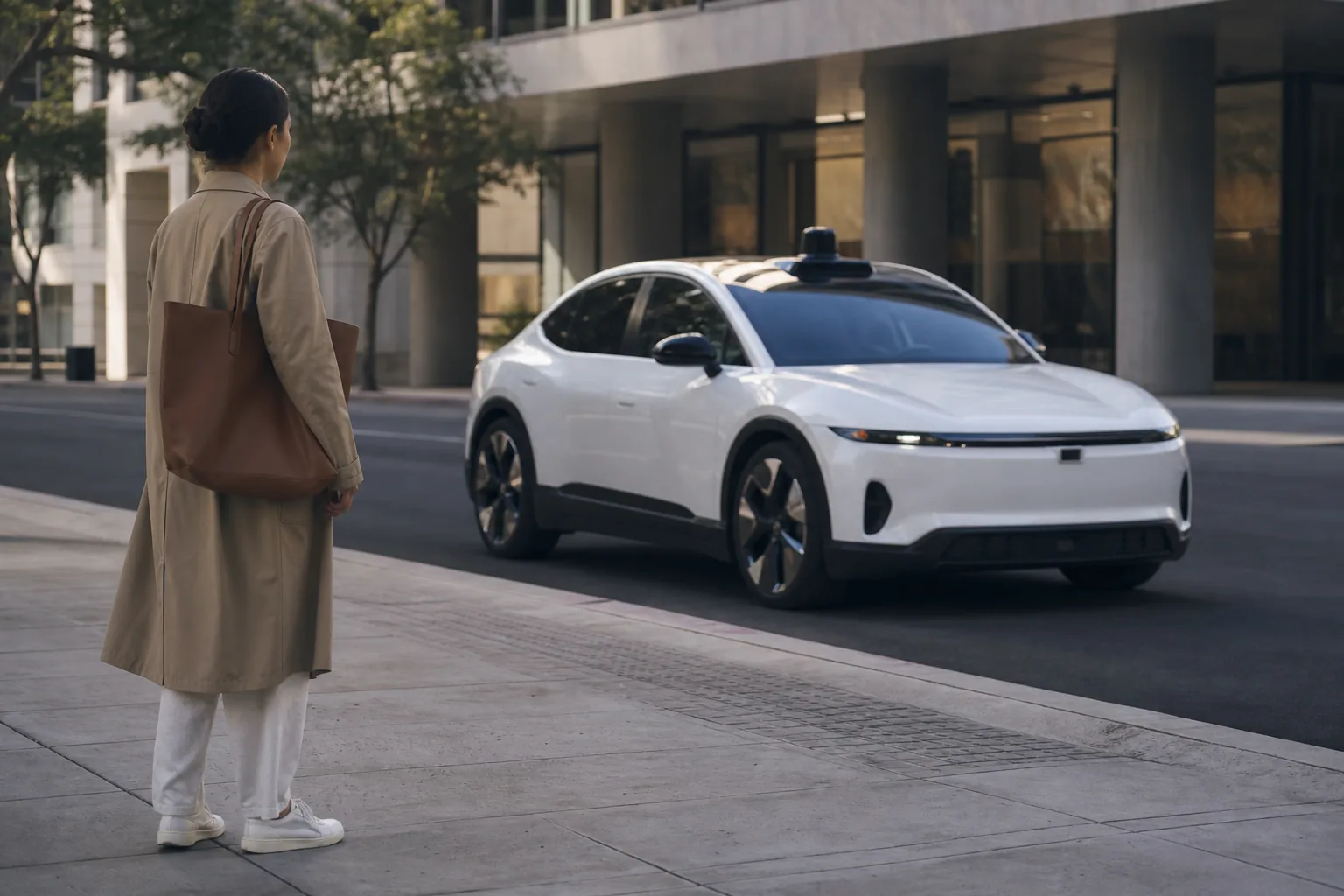
The short answer
A robotaxi identifies the right rider by their phone, not their face. As the rider approaches, the car broadcasts a short range signal that the phone recognizes as that exact vehicle, and a central server confirms the pairing. The car knows the person walking up is its rider before they reach the door.
No driver, no easy check
A human driver verifies a rider without thinking about it. They read the name in the app, glance at a face, maybe call it out. Take the driver away and that quiet check disappears with them.
A driverless car has to prove the same thing with signals alone. It needs to know that the person reaching for the door is the rider who booked it, not the one who booked the car behind it, and not a stranger trying a handle.
Ways to verify a pickup
The car has one question to answer at the curb: is this the right person? These are the ways to answer it, and how each holds up with no driver in the seat.
| Method | What the rider does | How it holds up without a driver |
|---|---|---|
| Spoken name | Says their name out loud | No driver to hear or check it |
| Typed PIN | Reads a code and taps it in | Codes get mistyped, shared, or shown to the wrong car |
| App confirm screen | Opens the app and taps confirm | Another step, and the phone has to come out |
| Proximity presence | Walks up with the phone in a pocket | The signal identifies the exact car automatically |
How presence identifies the rider
The method is proximity identification. The vehicle broadcasts a short range signal over Bluetooth, NFC, ultra wideband, or WiFi Direct. The rider phone detects it and identifies the nearest provider, which here is the car itself.
That pairing registers with a central server. The car and the phone never connect to each other directly. The server holds the match, confirms it, and tells the vehicle its rider has arrived. Ultra wideband suits this step well, because it ranges to within about ten centimetres, a precision maintained by the FiRa Consortium, so two cars stopped close together can still be told apart.
Why a PIN is a workaround
A pickup PIN is a patch for a car that cannot recognize you. It moves the effort onto the rider, who has to read a number and match it to a vehicle, often at night, often in traffic. Presence removes the number entirely. The car recognizes the phone, so there is nothing to read, type, or say out loud.
What it takes to build this
Recognizing a rider by presence sounds simple and is not. The hard parts are singling out the one correct vehicle among many nearby, keeping the two devices from connecting directly, and routing the confirmation through a server both sides trust.
That architecture is patented. Parousya Technologies holds the parent patent US10657515B2, covering proximity identification and server routed transactions, and the divisional US11392923B2, which adds third party querying and identifying a person without a payment. The patents are granted and validated across eleven jurisdictions, including the United States, the United Kingdom, Germany, France, and Singapore. A team building robotaxi pickup can license the method rather than reinvent it.
Common questions
- How does a robotaxi know who to pick up?
- It recognizes the rider phone over a short range signal and confirms the pairing through a central server, so it can pick its passenger out of a crowd at the curb.
- What if two robotaxis arrive at once?
- Each car identifies the nearest matching phone, and ultra wideband ranging can separate vehicles that are close together, so the rider does not have to work out which car is theirs.
- Does the car use face recognition?
- No. The method identifies your device by presence, not your face, which keeps a biometric out of the pickup entirely.
- Does my phone connect directly to the car?
- No. The two devices never connect directly. Each communicates with a central server, which holds and confirms the match.
- What replaces the pickup PIN?
- An automatic short range pairing. The verification still happens, but the system does it by signal and server instead of asking the rider to read a code.
Sources
- Guide: how do robotaxis workHow a driverless taxi operates.
- Rideshare and robotaxiThe full use case.
- Glossary: proximity identificationHow presence becomes identity.
- Glossary: server routed transactionHow the confirmation travels.
- NFC vs Bluetooth: which is better?The radios behind the sensing.
- What is cashierless checkout?The same identity problem, in a store.