
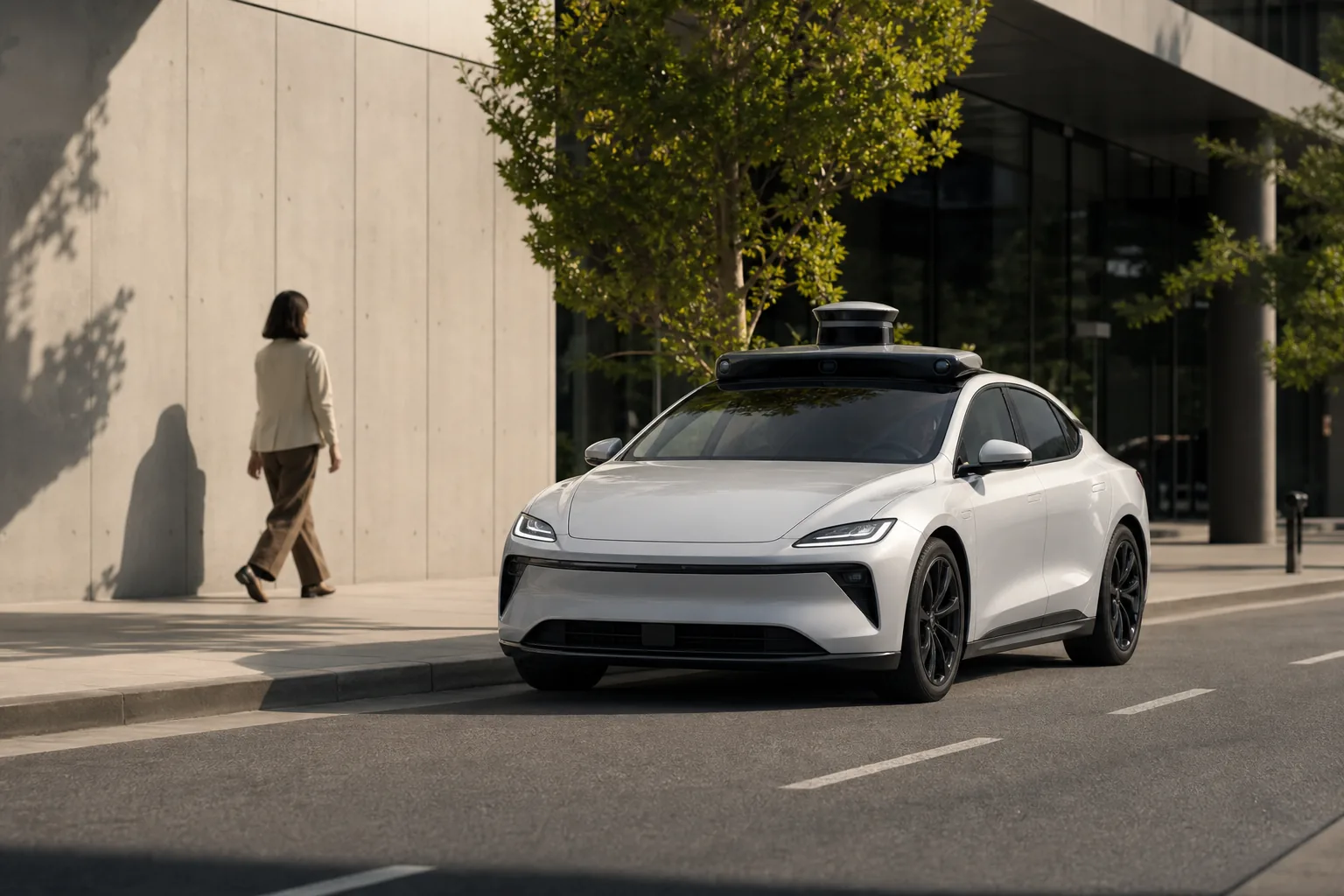
A robotaxi drives itself using a stack of sensors, a high definition map, and software that plans every move. Cameras, radar, and lidar build a live model of the road, the software places the car on the map and predicts what others will do, and a remote operations team supervises from afar. What the driving stack does not solve is the curbside handshake: proving that the person approaching is the rider who booked, and letting them pay with no driver in the loop. That identity and payment step is where proximity identification fits.
The robotaxi sensor stack
A robotaxi perceives the world through several sensors at once, because no single one is enough. Cameras see colour, text, and shape, which is how the car reads traffic lights, signs, and lane markings. Radar measures range and speed by bouncing radio off objects, and it keeps working in rain, fog, and darkness. Lidar times laser pulses to build a precise three dimensional picture of the shapes around the car.
These feeds are combined in a step called sensor fusion. Each sensor covers the others' weaknesses, so the car's model of the scene stays reliable when any one source is degraded. On top of the live sensing sits a high definition map, a detailed prior record of the road that the car matches against what it currently sees.
How a robotaxi plans and drives
Driving runs as a continuous loop. Perception turns the sensor feeds into a list of objects and their positions. Prediction estimates where those objects will go next, since a car has to act on where a pedestrian will be, not only where they are. Planning chooses the car's own path, and control turns that path into steering, acceleration, and braking.
Underpinning the loop is localization, the car placing itself on its high definition map to within a tight margin, so it knows its lane and its position at a junction. Most robotaxi services also run inside a defined operating area, sometimes called an operational design domain, and lean on a remote assistance team that can advise the car when it meets something unusual.
This is a mature and improving pipeline. It gets the car to the right place safely. What it does not do is settle who the car is there for, because that is a question about a person and an account, not about the road.
What each sensor contributes
The sensors are complementary, and the reason a robotaxi carries several types is that each has a clear strength and a clear limit. The table sets them side by side, in qualitative terms rather than exact specifications.
| Sensor | What it senses | Strength | Limit |
|---|---|---|---|
| Camera | Colour, text, and shape as images | Reads signs, lights, and lane markings | Struggles in glare, fog, and darkness |
| Radar | Range and speed by radio reflection | Works in rain, fog, and darkness | Coarse on fine shape and detail |
| Lidar | Distance by timing laser pulses | Precise three dimensional shape | Degrades in heavy weather |
| GPS and HD map | Global position against a stored map | Places the car on the road network | Coarse alone, and weak among tall buildings |
The unsolved problem: the curbside handshake
A robotaxi can navigate to a pickup point flawlessly and still face a problem the driving stack was never built to solve. Several people may be standing at that corner. Which one booked the ride? And once the right person is in the car, how do they pay when there is no driver to confirm anything?
The usual answers are clumsy. A PIN read aloud to no one, a button in an app that honks the horn, a scramble to match a licence plate against a screen. Each puts the work on the rider and none of them is a clean, trustworthy handshake between the person and the car. The gap is not perception. It is identity and payment at the curb.
This matters more as the driver disappears, because the driver used to be the handshake. A human could glance at a name, judge the situation, and take payment. Remove the driver and that social confirmation has to be rebuilt in software, precisely and safely, in a crowd.
How proximity identification answers the pickup
Parousya's patented proximity method is built for exactly this handshake. Patent US10657515B2 covers how the car broadcasts a short range signal, the rider's phone detects it and identifies the correct car among the line, that pairing registers with a central server, and the fare then routes through the server. The car and the phone never connect directly, so there is nothing to pair by hand and no code to read aloud.
In a crowded rank, telling the booked car from the one behind it is a precision problem, and this is where the fine ranging of ultra wideband helps the method resolve the single right vehicle. The rider does not aim a camera or type a PIN. Being beside the correct car is the instruction, and nothing is sent until the rider chooses to act.
The divisional patent US11392923B2 adds two capabilities that suit a driverless pickup. Identification without a payment lets the system confirm the right rider is at the right car before the doors open, with no charge attached. Third party querying lets an authorized platform ask about a pairing, so the operator can verify a match without either device talking to the other. Together they rebuild the driver's old confirmation as a server held fact rather than a guess.
The two devices never connect directly.
Confirming the right rider, not just the right car
A good curbside handshake has to satisfy two parties at once. The rider needs to know this is their car, and the system needs to know this is the right rider before it unlocks or charges. A method that only reassures one side leaves the other exposed.
Because the pairing lives with the server and presence is confirmed before anything moves, both sides get their assurance from the same trusted place. That two way confidence is also why this connects to taxi safety, where confirming who is in which vehicle can matter as much as the fare. The payment is almost a side effect of getting the identification right.
Common questions
- How does a robotaxi drive itself?
- It fuses cameras, radar, and lidar into a live model of the road, localizes itself on a high definition map, then predicts what others will do and plans its path. A remote team supervises and can assist when the car meets something unusual.
- What sensors does a robotaxi use?
- Cameras for colour and text, radar for range and speed in poor weather, lidar for precise three dimensional shape, and GPS against a high definition map for position. Each covers the others' weaknesses through sensor fusion.
- How does a robotaxi know who to pick up?
- The driving stack does not solve this. Proximity identification does. Patent US10657515B2 has the car broadcast a signal that the rider's phone detects and matches, registering the pairing with a server so the right person and the right car are confirmed.
- How do you pay in a robotaxi with no driver?
- The fare routes through a central server once the rider and car are paired by presence, under patent US10657515B2. The two devices never connect directly, and nothing is charged until the rider chooses to act.
- Can the system confirm the rider before unlocking?
- Yes. The divisional patent US11392923B2 covers identification without a payment, so the right rider can be matched to the right car before the doors open, and third party querying lets an authorized operator verify the pairing.
Sources
- What is ultra wideband?The precise ranging that picks the right car.
- What is geofencing?Why a location boundary is not enough.
- The proximity methodThe identification and payment method in full.
- Proximity identification, definedPicking the right provider among many.
- Rideshare and robotaxiThe curbside handshake as an industry problem.
- Taxi safetyConfirming who is in which car.