
The short answer
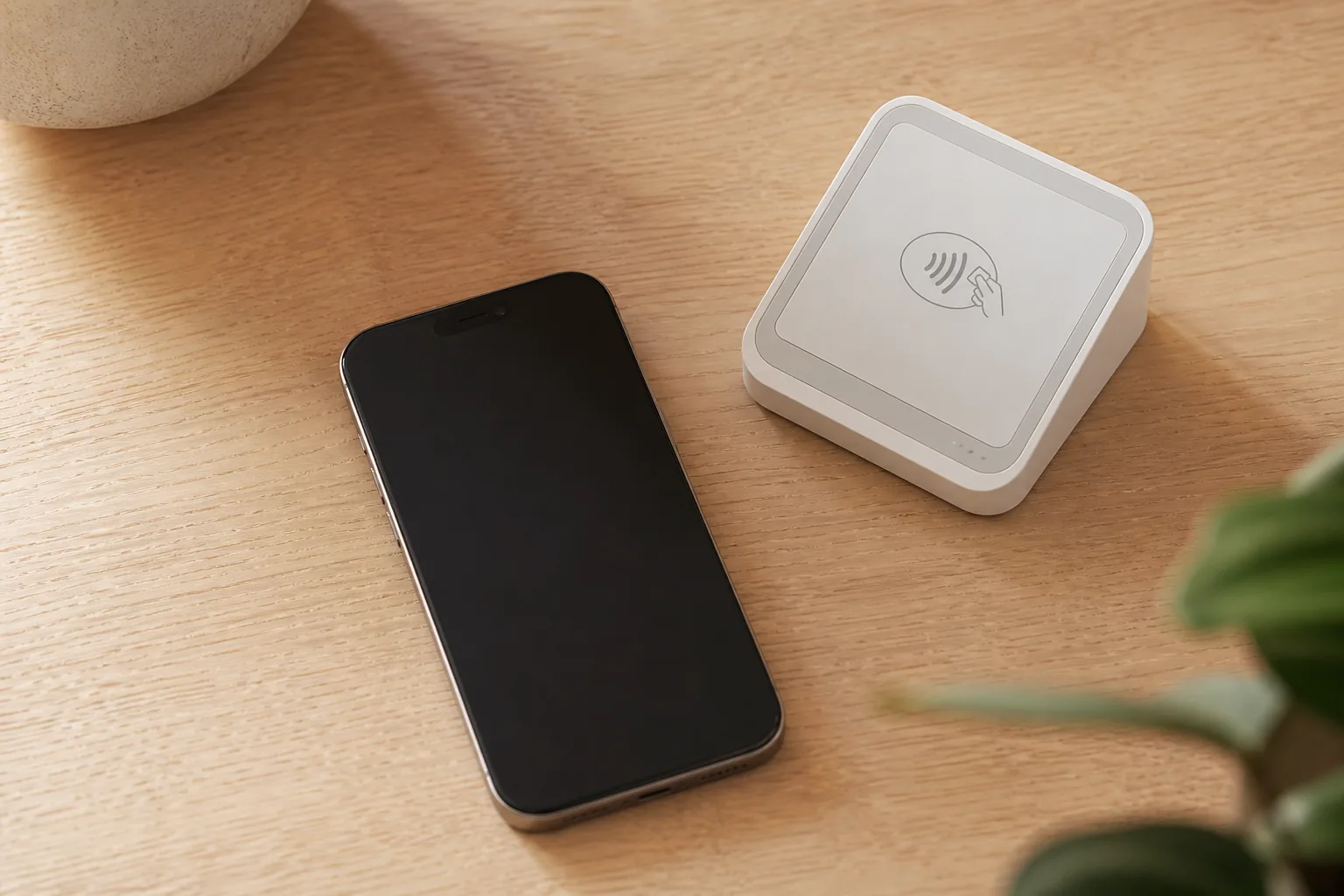
NFC stands for Near Field Communication. It is a short range wireless standard that lets two devices exchange a small amount of data when they are held within a few centimetres of each other. On a phone it is the radio behind tap to pay, transit passes, and the NFC tags you read by touch.
What the three letters mean
Each word describes a real property of how the radio works, so the name is worth reading literally.
These characteristics are defined and maintained by the NFC Forum, the body that governs the standard.
- NearThe range is deliberately tiny, a few centimetres. You have to bring the two devices almost together, which is what makes a tap feel intentional.
- FieldNFC works through a magnetic field at 13.56 MHz. One device generates the field and the other draws from it, which is how a phone can power a battery free tag.
- CommunicationData moves both ways. The two sides can identify each other and exchange a short message, not just beam in one direction.
What NFC does on your phone
If you have seen NFC listed in your phone settings, it is the single switch that enables all of these.
- Tap to payYour phone wallet emulates a contactless card so you can pay by holding it to a reader.
- Transit and accessTransit passes and building badges ride on the same short tap.
- Reading tagsA quick touch reads an NFC tag, which can open a link, join a network, or trigger a shortcut.
- Quick pairingA tap can hand a connection off to Bluetooth or WiFi so a longer session takes over.
NFC and the radios around it
NFC is one of several short range radios, and the differences are mostly about range and how deliberate the action is.
| Radio | Typical range | How it starts |
|---|---|---|
| NFC | A few centimetres | A deliberate tap |
| RFID | Centimetres to metres | A reader energizes a tag |
| Bluetooth Low Energy | Up to tens of metres | A background connection |
| Ultra wideband | Metres, with fine ranging | Continuous precise ranging |
Where the tap ends and proximity begins
NFC is really a short range, high frequency case of RFID. Its few centimetres are its strength and its ceiling. A tap proves intent, because you had to reach and touch, but it also means you must reach and touch. The phone has to come out and meet the reader.
A newer approach treats NFC as just one transport it can sense. In the proximity method patented by Parousya Technologies, a provider broadcasts a short range signal over any of Bluetooth, NFC, ultra wideband, or WiFi Direct. The phone detects it, identifies the nearest provider, and the transaction routes through a central server, so the two devices never connect directly and nothing is sent until you choose to act. The parent patent US10657515B2 covers that proximity identification and server routed payment, and the divisional US11392923B2 adds identifying a person without a payment at all.
So NFC answers what the letters mean. The proximity method answers what comes after the tap.
Common questions
- What does NFC stand for?
- NFC stands for Near Field Communication. It is a short range wireless standard, defined by the NFC Forum, that lets two devices exchange data over a few centimetres.
- Is NFC the same as RFID?
- Not quite. NFC is a short range, high frequency case of RFID. All NFC is a form of RFID, but most RFID, such as long range warehouse tags, is not NFC.
- Does NFC work without internet?
- Yes. The tap itself is a local radio exchange and needs no internet. A connection is only needed later, for example when a payment terminal authorizes a charge.
- What is NFC on my phone used for?
- Mostly tap to pay, transit and access passes, quick pairing, and reading NFC tags. It is the same radio behind all of them.