
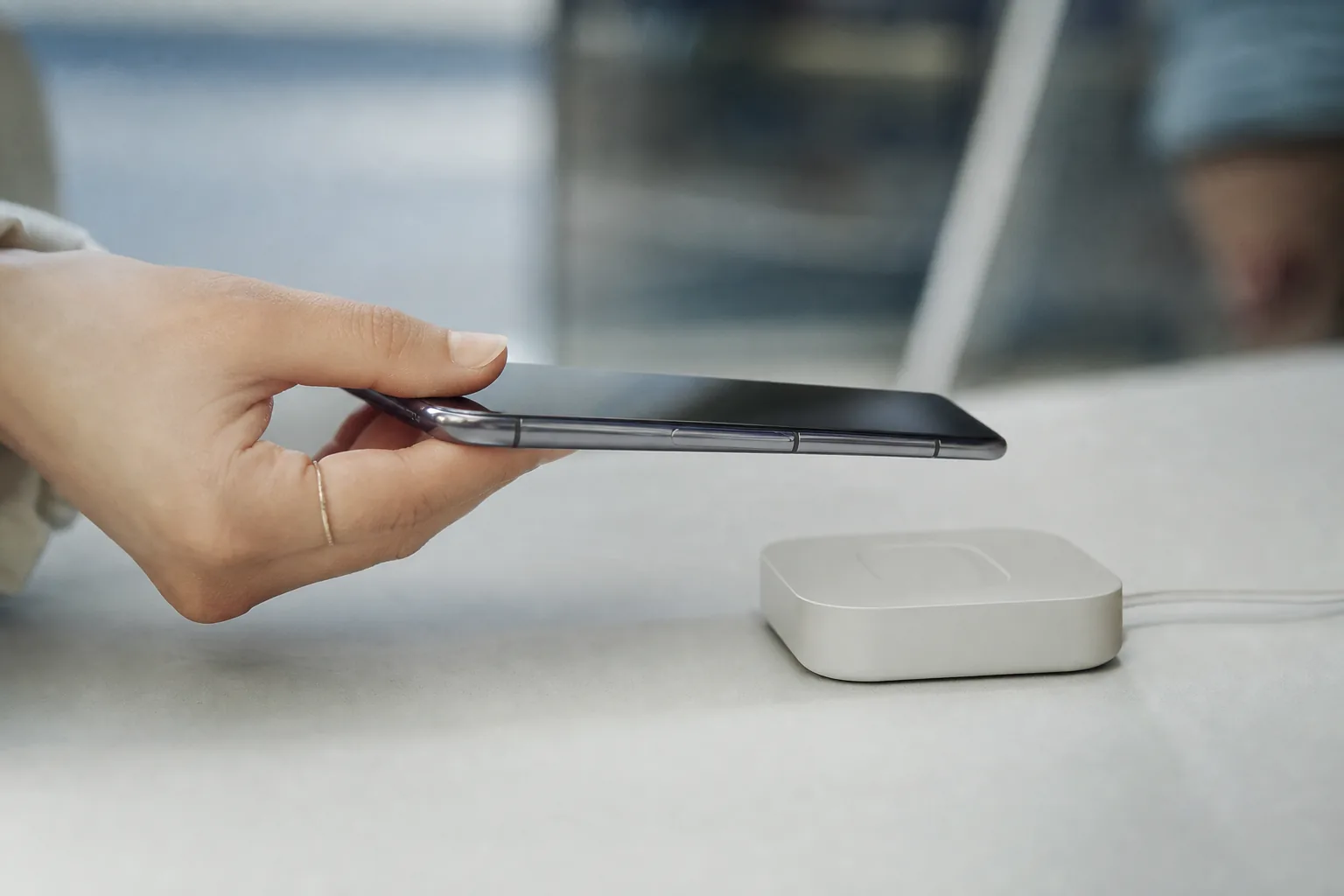
NFC stands for Near Field Communication, a short range wireless standard that lets two devices exchange data when they are within a few centimetres of each other. It runs at 13.56 MHz and works by inducing a current in a nearby chip, so a passive tag needs no battery of its own. On a phone, NFC is what powers tap to pay, transit cards, digital keys, and tapping to read a smart tag. Its defining trait is intimacy: a tap says exactly which two devices meant to talk.
What NFC stands for
NFC stands for Near Field Communication. It is a short range wireless standard maintained by the NFC Forum, built so two devices can exchange a small amount of data when they are held within a few centimetres of each other. The name is literal. The communication happens in the near field of the radio, the region right next to the antenna, which is why the range is so short.
That short range is a feature, not a limitation. Because an NFC link only forms at contact distance, bringing two devices together is an unambiguous act of intent. You do not accidentally tap a reader from across a room.
How NFC works
NFC operates at 13.56 MHz, a frequency the NFC Forum standardizes. One device, the initiator, generates a small magnetic field. When a second device or a passive tag enters that field, the field induces a current in its antenna, and that borrowed energy is enough to power the chip and let it answer. This is why a contactless card or a sticker tag can work with no battery at all.
There are two roles in any NFC exchange. An active device, such as a phone or a reader, generates its own field. A passive target, such as a tag or a card, relies on the initiator's field for power. A phone can play either role, which is how the same handset can act as a card at a terminal one moment and read a tag the next.
The exchange is short by design. NFC is meant for a quick, deliberate handshake, not for streaming data, so protocols that need more bandwidth or range hand off to Bluetooth or WiFi once the NFC tap has introduced the two devices.
What NFC does on your phone
If you have wondered what NFC is on your phone, it is the chip and antenna that let the phone tap to do things. The most visible use is tap to pay, where the phone behaves like a contactless card. Apple Pay and Google Wallet are the common examples, and both ride on the same NFC radio.
Beyond payments, NFC reads and writes smart tags, unlocks digital car and hotel keys, pairs accessories with a single tap, and stands in for a transit card. In each case the phone is either powering a passive tag or presenting itself as one. The pattern is always the same: hold the phone close, and a short exchange happens without any menus.
NFC compared with other short range radios
NFC is one of several short range radios, and each trades range for a different strength. NFC is the closest ranged and the most deliberate. RFID is its longer ranged relative. Bluetooth Low Energy reaches across a room at low power, and ultra wideband adds precise distance measurement. The figures below are the widely documented behaviour of each standard, not exact specifications.
| Technology | Typical range | Battery in the tag | Common use |
|---|---|---|---|
| NFC | A few centimetres | None; the reader's field powers a passive tag | Tap to pay, transit, digital keys, tags |
| RFID (UHF) | Metres, well beyond NFC | Passive tags need none; the reader powers them | Inventory, logistics, access cards |
| Bluetooth Low Energy | Up to tens of metres | Yes, a beacon carries its own battery | Beacons, presence, accessories |
| Ultra wideband | Short range, with fine ranging | Yes, an active radio | Precise device finding, secure keys |
NFC and RFID
NFC is best understood as a special, short range case of RFID. Both work by a reader powering a tag over radio and reading what it sends back. The difference is range and intent. Passive UHF RFID can be read from metres away, which suits scanning a pallet of goods, while NFC is capped at a few centimetres, which suits a deliberate tap.
That distinction matters for design. If the goal is to detect a tag without the holder doing anything, longer range RFID fits. If the goal is a single, intended interaction, NFC's contact range is the point. Neither is better in the abstract. They answer different questions.
NFC as one sensing channel for proximity payment
NFC's guarantee, that a tap identifies exactly which two devices meant to interact, is valuable well beyond a payment terminal. It is a clean signal of presence and intent. The question is what to do when the customer and the provider are near each other but a tap is impractical, such as a rider approaching one car among several.
Parousya's patented proximity method treats NFC as one of the radios it can sense, alongside Bluetooth, ultra wideband, and WiFi Direct. Patent US10657515B2 covers how a provider's broadcast is detected, the nearest provider is identified, and the payment is routed through a central server so the two devices never connect directly. Where a tap needs contact, the method can also lean on radios that reach further, then still resolve the single right provider.
The divisional patent US11392923B2 adds identification without a payment, so presence can be confirmed on its own. In that framing NFC is not the whole system. It is one dependable way, among several, to prove who is near whom before anything is charged.
Common questions
- What does NFC stand for?
- Near Field Communication. It is a short range wireless standard, set by the NFC Forum, that lets two devices exchange data over a few centimetres at 13.56 MHz.
- What is NFC on my phone?
- It is the chip and antenna that let your phone tap to act. NFC powers tap to pay, transit cards, digital keys, tag reading, and one tap pairing. Hold the phone close to a reader or tag and a short exchange happens automatically.
- How far does NFC reach?
- A few centimetres. NFC works only in the near field right next to the antenna, so the two devices have to be almost touching. That short range is deliberate, because it makes a tap an unambiguous act.
- Is NFC the same as RFID?
- NFC is a short range, standardized case of RFID. Both use a reader to power a tag over radio, but passive UHF RFID reaches metres while NFC is capped at a few centimetres for deliberate, one at a time interactions.
- Does proximity payment require NFC?
- No. NFC is one of several radios the patented proximity method can sense, alongside Bluetooth, ultra wideband, and WiFi Direct. Patent US10657515B2 routes the payment through a server, so the method does not depend on a tap.
Sources
- How does tap to pay work?NFC carrying a contactless payment.
- What is NFC mobile payment?NFC wallets and the rails behind them.
- What is ultra wideband?The radio that adds precise ranging.
- NFC, definedThe short definition and related terms.
- NFC vs RFIDThe short range case against its longer ranged relative.
- RetailWhere a tap and its successors meet the counter.